
Your AI agents are everywhere.
Your AI value is nowhere.
Roiva measures what every agent, pilot, and initiative costs and what it returns, then brings each one up on a schedule — so the call to scale, fix, or cut is made on numbers your CFO will accept, and stays on the record with the figures behind it.






The problem
Companies are deploying AI agents everywhere.
Almost no one manages them like an investment.
AI pilots succeed in the lab and disappear in the budget review.
An AI portfolio nobody can see
Agents, pilots, and models are scattered across teams with no shared view of cost, ownership, or outcome.
No number finance will sign
Teams can't show the dollars an AI initiative saved or earned in a form finance accepts, so budgets get cut on instinct.
No blueprint for what to try
It's hard to know where AI will actually move the needle for your specific business — without a structured way to look.
What counts
Where AI value actually comes from
Every dollar of value on the record is one of four types, and none of it counts until it's approved.
A workflow that got cheaper — synced automatically from your cloud and model-API bills, or logged manually against a baseline.
A deal closed or upsized with AI's help — tied back to the CRM opportunity, not estimated after the fact.
Hours a team got back, converted to dollars using your own loaded labor rate — not an industry benchmark.
Spend you didn't have to take on — a hire you skipped, a renewal you dropped — logged against the plan it replaced.
How it works
From first idea to the board report
Every initiative goes on the record at the idea stage and stays there, from "we're exploring AI" to "AI delivered $X this quarter."
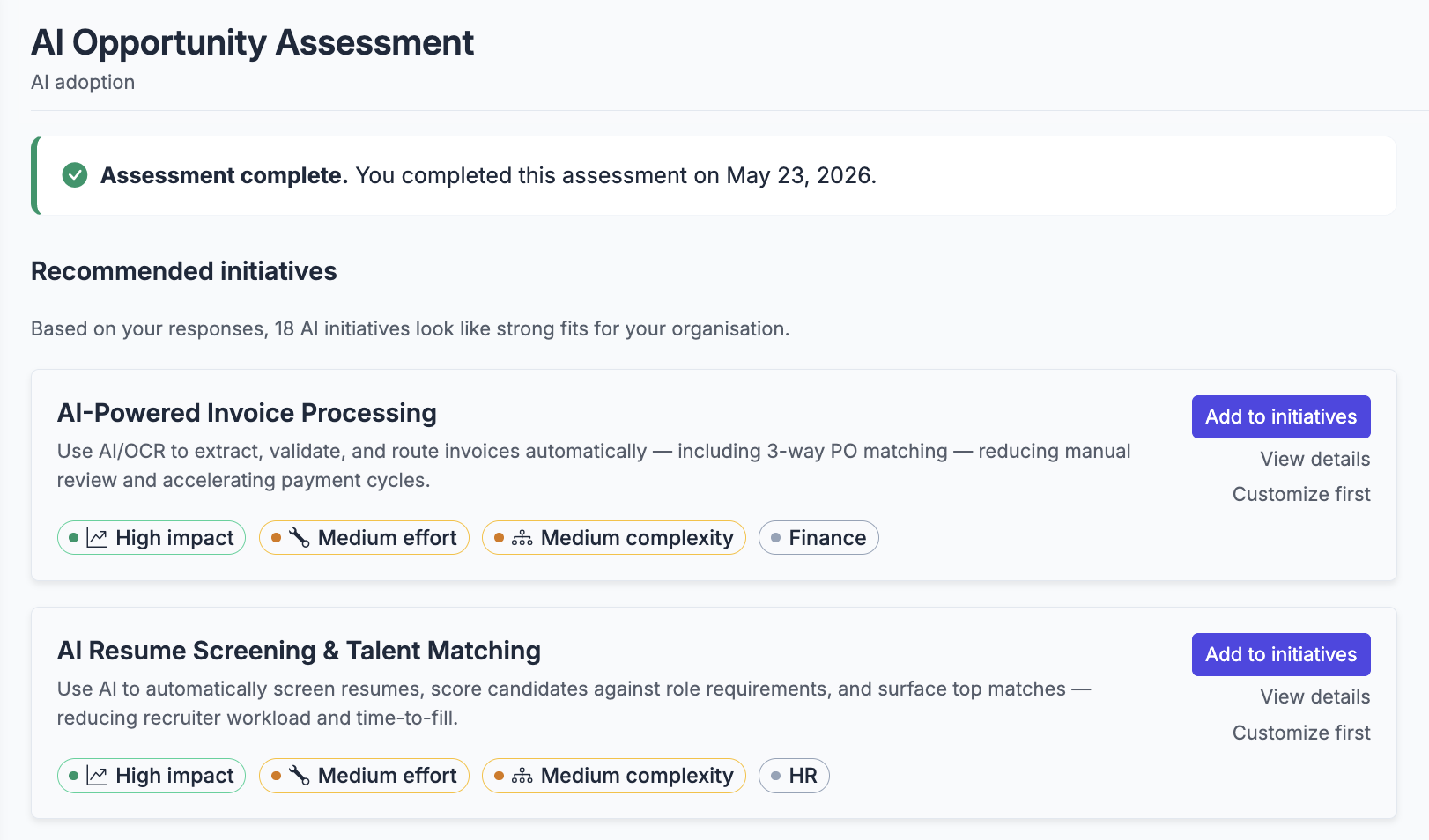
Assess your business
Answer questions about your workflows and goals. Get a tailored AI ROI exposure report by function.
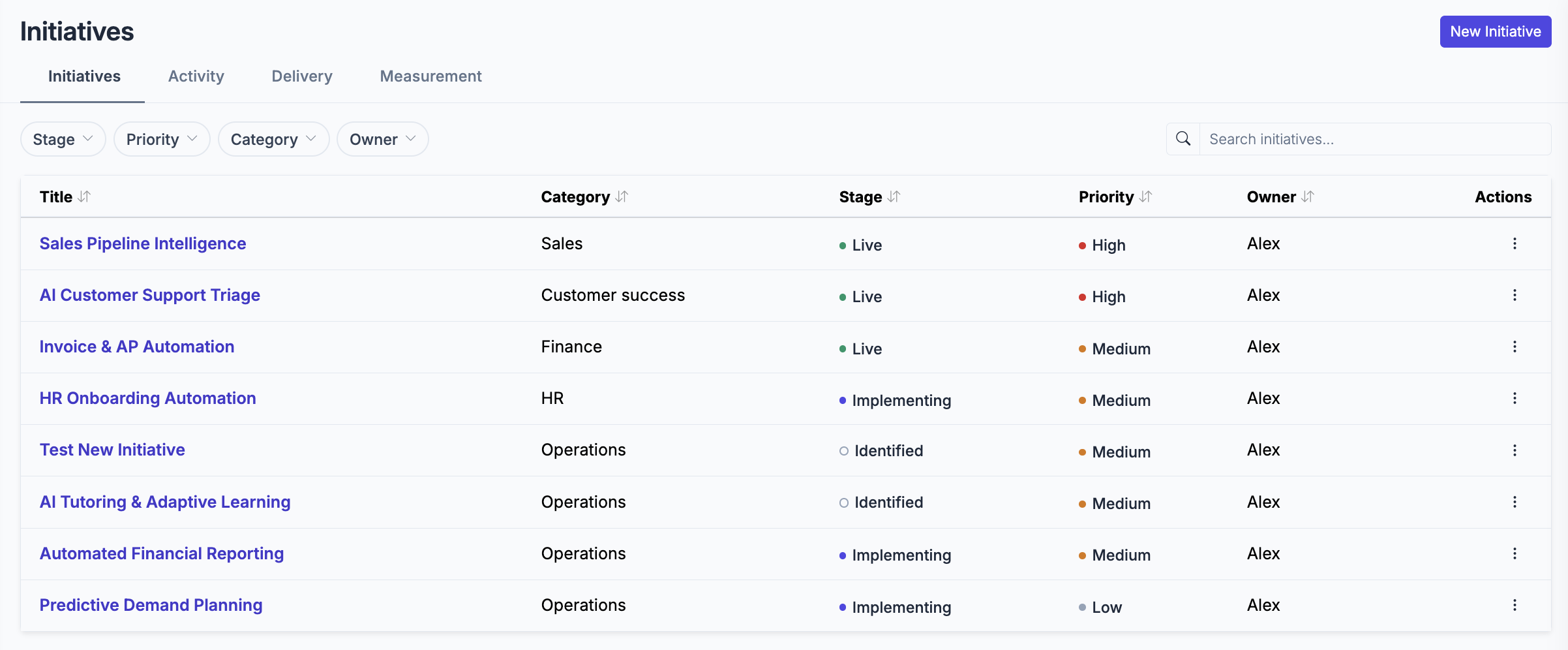
Put every initiative on the record
Owner, stage, costs, and expected return for every AI project, in one place across your organization.
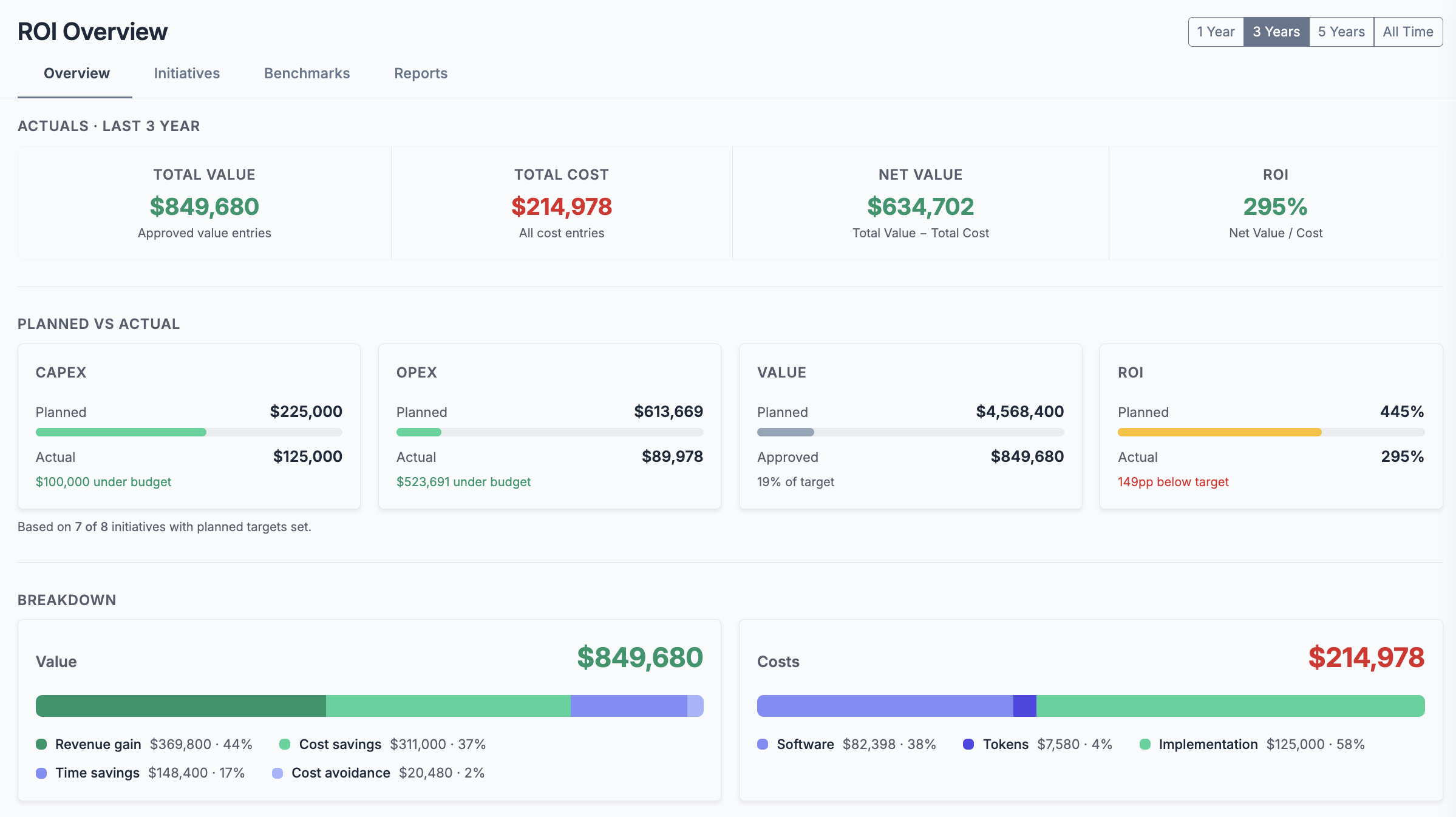
Report ROI finance signs off on
Connect your existing tools. Value lands in dollars and counts only once it's approved, not as activity metrics or vanity numbers.
Why Roiva
A record, not a report
Spreadsheets and dashboards show you a number. Roiva keeps the record behind it: the costs, the formula, the source data, and the approval.
- Manual entry; nobody updates it after month two
- No connection to CRM, support, or cloud spend
- Formulas break when the methodology changes
- One person owns it; nobody else trusts it
- Tokens consumed, prompts run, calls made
- No link from spend to business outcome
- Treats AI as a cost line, not a portfolio
- CFO can't tell if AI paid back the investment
- Every dollar traces to a formula, a source record, or a named person
- 30+ integrations sync cost and value automatically
- Approval workflow keeps unrealized value out of reported ROI
- Approved budgets tracked against actual spend, with increases above your approval threshold signed off before they apply
- Portfolio reviews record what to scale, fix, or cut, with the numbers behind each call
- Every agent, pilot, and model on one auditable record, from business case to retirement, across sales, ops, support, and finance
Examples
What AI ROI looks like in practice
Illustrative figures, not customer results. Each card names the formula a return like it is built from.
Common questions
What finance and ops leaders ask first
How is this different from a spreadsheet, a FinOps tool, or a BI dashboard?
We don't have baselines yet. Is it too early?
How long until we have a number we can defend?
Who owns this — finance, or the teams running AI?
Will the numbers hold up with our CFO or board?
How is Roiva priced?
How do you handle our data and security review?
See where your AI ROI exposure sits today.
Take the free AI ROI Exposure Assessment. Get a one-page report showing your estimated AI spend exposure, where ROI is provable today, and the highest-leverage moves to close the gap.
Get your exposure report →Free · Anonymous · ~ 5 minutes · No account required